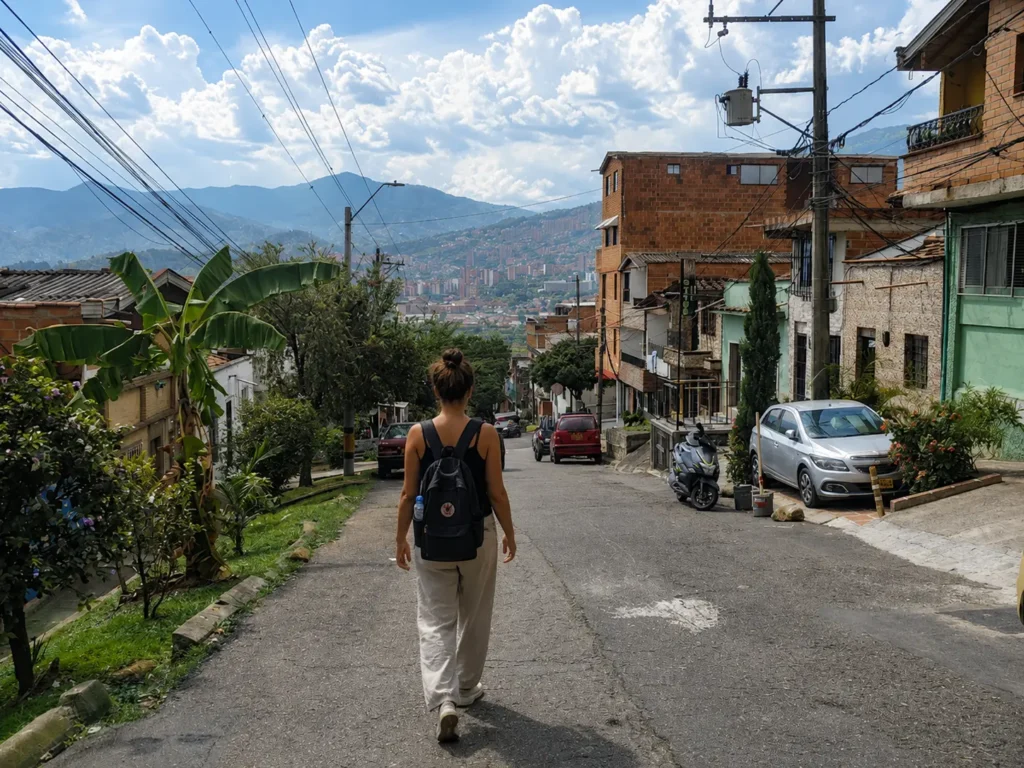
If you’ve searched for information about solo female travel, you’ve probably noticed that almost every article revolves around one topic: safety. As if that’s the defining feature of traveling alone as a woman.
The result is that conversations about solo female travel often become conversations about fear. Instead of talking about the places you’ll discover, the people you’ll meet or the freedom that comes with traveling on your own, we’re met with endless lists of precautions. And, ironically, many of them have very little to do with travel itself.
Share your location with someone. Let a friend know when you get back. Meet strangers in public places. Trust your instincts. None of those are bad ideas. The problem is that they’re not really travel advice. They’re things many women already do in their everyday lives, whether they’re at home or on the other side of the world.
In another article, I wrote about why I think the conversation around solo female travel often misses the point, and what the available data actually says about safety. If you’re wondering whether women are inherently at greater risk simply because they’re traveling alone, I’d recommend starting here.
This article is about something different.
Rather than discussing fear, I want to focus on the practical decisions that actually make me feel safer while traveling alone through Latin America. Interestingly, most of them have very little to do with being a woman. They’re the kind of habits that make travel easier for anyone, whether you’re backpacking for six months or taking your first solo trip abroad.
I don’t travel expecting something bad to happen, but I don’t believe in leaving everything to chance either. Nothing is enjoyable if you’re constantly anticipating the worst, but that doesn’t mean throwing caution out the window. For me, traveling safely isn’t about being afraid. It’s about reducing uncertainty.
The more information I have before I arrive somewhere, the fewer decisions I have to make when I’m tired, overwhelmed or completely unfamiliar with my surroundings. That doesn’t eliminate risk—nothing does—but it gives me more confidence, more flexibility and, ultimately, more mental space to enjoy the trip itself.
Table of Contents
Safety starts before you arrive
Many of the decisions that have the biggest impact on how safe I feel while traveling are made before the trip even begins. Where I stay, how I’ll get there from the airport, and how much I’ve figured out before I arrive all shape the way I experience those first few days. None of these decisions guarantee that nothing will go wrong, but they make it much easier to navigate a place I don’t know yet.
Choosing where to stay
Accommodation is usually the first thing I plan. Choosing the right neighborhood isn’t just about finding a nice hotel or hostel—it shapes the entire trip. It affects how easy it is to get around, how much time you’ll spend commuting, and whether you’ll feel comfortable walking back after dinner or heading out early in the morning.
When I’m traveling somewhere I’ve never been before, choosing where to stay isn’t always straightforward. Hotel photos can tell you what the room looks like, but they won’t tell you what the neighborhood feels like. You can’t tell whether it’s busy or quiet, whether people are still out in the evening, or whether it’s an area where you’d feel comfortable walking around on your own.
When I don’t have a clear picture of the city, I usually start with a map rather than browsing accommodation one by one. I open Booking (or any accommodation platform), switch to the map view, and look for areas with a high concentration of hotels and hostels. Those neighborhoods are often a good starting point because they’re popular with travelers. Once I’ve identified them, I spend some time researching what they’re actually like before deciding where to book.
There’s one thing I’ve learned while traveling through Latin America, though. In many cities, the historic center isn’t necessarily the best place to stay. It’s often where you’ll find the biggest concentration of tourist attractions, but also some of the busiest streets during the day and, in many cases, the quietest ones at night. These neighborhoods are usually worth exploring, but not always where I want to sleep. Personally, I’d rather stay in a residential area with cafés, supermarkets and people going about their daily lives throughout the day, even if accommodation costs a little more.
Planning your arrival
The other thing I always figure out before leaving home is how I’m going to get from the airport or bus terminal to my accommodation.
This is often one of the most demanding moments of a trip. You’ve probably been traveling for hours, you’re tired, carrying your luggage, and trying to make sense of a place you’ve never been to before. Leaving this part to chance usually means making unnecessary decisions when you’re least prepared to make them.
Before every trip, I look into the available transport options, how long they take, how they’re paid for and roughly how much they cost. If public transport is a good option, great. If ride-hailing apps are more practical, I want to know that before I land. I don’t need every detail planned in advance, but I like arriving with a clear idea of my options instead of trying to figure everything out on the spot.
Google Maps is one of the tools I use most for this. Besides checking routes, I can estimate travel times, see public transport schedules and download offline maps before I arrive. I also make sure I know how transport works in that destination. Do I need cash? Can I pay with a contactless card? Is there a transport card I should buy? These are small details, but sorting them out beforehand makes arriving somewhere new much less stressful.
Connectivity as a backup: one less thing to worry about
One of the things that makes arriving somewhere new much easier is knowing you’ll have internet access as soon as you land. Whether you need to check directions, message your accommodation, book a ride or simply let someone know you’ve arrived safely, having a connection removes a lot of unnecessary uncertainty during the first hours of a trip.
Over the past few months I’ve noticed more and more solo travelers solving this by using eSIMs. Not long ago I was chatting with a woman from Switzerland who’d been traveling alone through Latin America for several months, and she told me she’d activated an eSIM before leaving home. It meant she didn’t have to look for a local SIM card in every new country or worry about whether her phone plan included roaming. She simply landed with data already working.
An eSIM is a digital SIM you activate by scanning a QR code. If your regular plan doesn’t include affordable international roaming, it’s an easy way to stay connected from the moment you arrive. In some countries, including Peru, buying a local SIM as a tourist isn’t always as straightforward as you might expect, so having your connectivity sorted out in advance can make those first few hours considerably less stressful.
➜ Check out Saily’s eSIM plans This is an affiliate link. If you sign up through it, I earn a commission at no extra cost to you.
Digital dependence while traveling
Away from home, your phone becomes a lot more than a way to communicate. It’s your bridge to almost everything — and a key part of making the trip actually work.
It sounds obvious, but it’s easy not to think about it until something goes wrong. Lose your phone, and you suddenly realize how much you were relying on it. No way to reach family or work, no access to your bank accounts or digital wallets, no social media, and in some cases, no way back to your accommodation because you don’t remember the address and have no GPS to guide you.
Losing your phone can genuinely put you at risk, or at least leave you far more exposed and slower to react. And a lot of that risk is avoidable with a bit of basic planning.
Something as simple as writing down important phone numbers, addresses, and basic information on paper can save your day — literally. It costs nothing and takes very little time: just save that information somewhere before you leave, ideally in more than one place.
The same logic applies to payment methods. Paying through an app or digitally is usually the fastest, most practical option, and it often means skipping currency exchange counters or banks altogether. That’s genuinely useful.
But it’s not smart to rely on a single option. Whenever I travel, I make sure to carry some cash for the unexpected. I also try to keep more than one digital wallet on my phone, not all of them visible on the home screen. I keep access to my bank accounts and wallets from my laptop too, in case one of those fails, and I carry physical cards as a backup for whenever digital payment doesn’t go through.
The reality is that every digital payment method — wallets or cards alike — is vulnerable to outages. It’s happened to me more than once, across different platforms. Having a backup isn’t overly cautious or paranoid; it’s just basic logistics that can save you a lot of trouble.
Sharing your plans
This is something many women already do automatically in everyday life. But while traveling, it matters even more.
Whether you’re heading out for a hike, going to a neighborhood farther from where you’re staying, or planning to come back late, it’s worth having at least one person know your plans for the day — and, if possible, roughly when you expect to be back. That could be someone from your family or friend group, but it’s also worth letting your accommodation know if there’s staff or a receptionist on site.
It’s also worth flagging if you don’t plan on returning that same night. Having worked in tourism myself, I know that a guest’s unexplained absence can cause real concern, and can even trigger emergency protocols without you knowing. A simple heads-up is enough — you don’t owe anyone an explanation, just a notice. And if plans change on the fly, it’s worth keeping an eye on your phone in case the accommodation tries to check in on you.
It’s not all precaution, either. Something I’ve noticed is that hotels and hostels tend to pay a bit more attention when a woman traveling alone checks in. In many cases, staff end up looking out for you a little more, often for the same reasons — real or assumed — that make people worry about solo travel in the first place.
For situations where you feel like you want an extra layer of security, you can also share your real-time location through apps like WhatsApp or whatever you normally use. There are even apps built specifically for this, offering continuous location sharing or panic buttons. It’s not about living on high alert — it’s about knowing simple tools exist for specific moments.
Rest and boundaries are safety too
As I mentioned earlier, traveling alone means staying more alert to your surroundings, and that takes energy. You’re out of your usual routine, walking more, moving through unfamiliar places, and taking in constant new stimuli. All of that adds up to fatigue — physical and mental.
In those moments, I try not to put myself in situations that demand a lot of attention. That doesn’t mean staying in or skipping things — it means adjusting what I do. I can still go out, explore, live a normal travel day, but I’ll avoid crowds, walking alone at night, or taking public transport during rush hour or in areas I don’t know well yet. Being tired doesn’t make you incapable, but it does slow down your reaction time, and that’s worth keeping in mind.
It’s also worth being clear about something: managing risk isn’t the same as traveling in fear. And traveling alone doesn’t mean traveling isolated. In fact, solo trips often lead to meeting people and building connections that last for years. It’s not about avoiding interactions — it’s about moving through them with judgment.
Two things matter here. The first is understanding that you don’t owe anyone friendliness. Many women — especially in Latin America — are raised to please, to soften, to connect through kindness even when what we actually mean is no. It’s rarely a conscious choice; it’s just deeply ingrained. And the problem is that, in trying not to seem rude, we sometimes stay in interactions that don’t feel comfortable.
The second is learning to recognize signals. Sometimes, in a place or with someone, a feeling shows up that’s hard to explain — something just doesn’t sit right. That’s not superstition or paranoia. It’s your brain and body processing information — gestures, tone, context — before you can consciously put it into words. Listening to that signal and stepping away from a situation is a valid decision, not an overreaction or a personal failure.
The bottom line
So, is solo travel actually dangerous?
The short answer is that traveling alone isn’t inherently more dangerous than traveling any other way — but it does mean operating under different conditions than your everyday life. The environment changes, your immediate support network changes, and so does how you respond when something unexpected happens.
The unease we often associate with solo travel doesn’t come from the destination itself. It comes from a combination of unfamiliarity, fatigue, and a reduced ability to respond. And that means most of the risk can be managed — through planning, logistics, and conscious decisions — without needing to travel from a place of fear or constant suspicion.
Traveling alone isn’t about isolating yourself or staying on guard all the time. It’s about learning to move with judgment, protecting your energy, relying on simple tools, and giving yourself permission to set boundaries when something feels off. It’s not about being brave or reckless — it’s about traveling informed, aware, and resourced.
And, above all, understanding that traveling doesn’t make you vulnerable by definition. It challenges you, sure. But it also trains you, strengthens you, and shows you — again and again — that you’re perfectly capable of moving through the world on your own terms.
Planning your first solo trip to Latin America?
Feeling confident about a trip often starts with having fewer unknowns. If you want help thinking through where to stay, how to get around, what to expect, or other practical decisions before you go, I can help you plan with more context and confidenc
➜ Continue reading:
What solo female travel is really about (and what gets ignored)
Travel Insurance in Latin America: How Healthcare Works and What to Consider
Estimating a Realistic Budget for Long-Term Travel in Latin America
Cash, cards and ATMs in Latin America: how money actually works for travelers