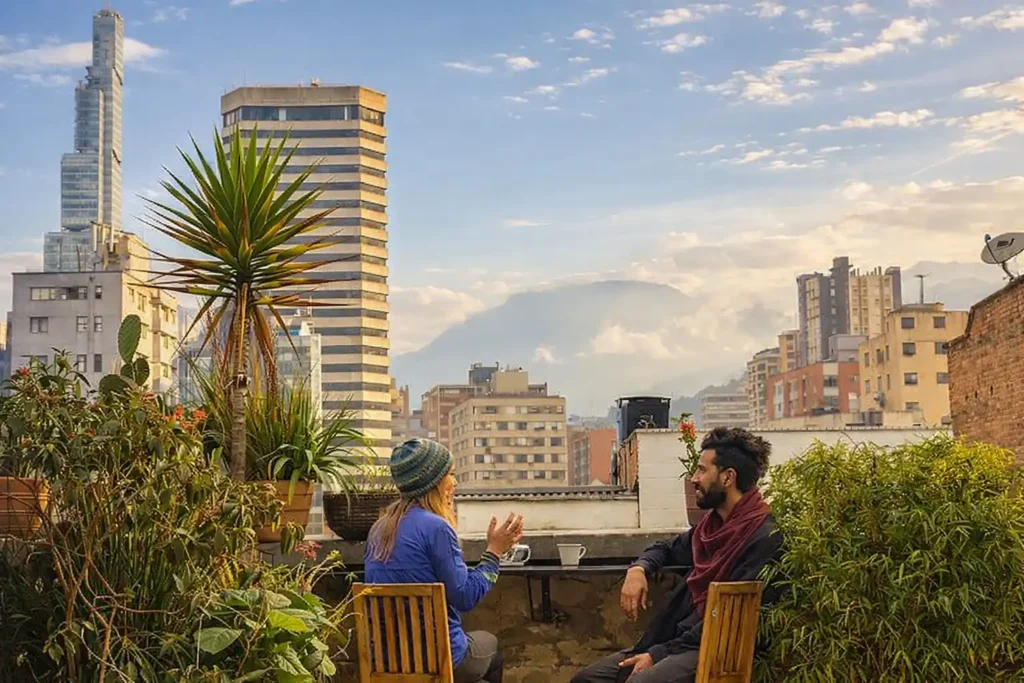
Because I travel full-time, I meet other travelers constantly—in hostels, tourist hotspots, buses, cafés. When I talk to them, I meet many people who can speak Spanish but didn’t learn it in a structured way. They picked it up through immersion, just by traveling and interacting with people across Latin America.
These are people who don’t speak perfectly, but can communicate very well. They’re functional, and many of them have little to no accent. The vocabulary and phrasing they use can sound very local, because they pick up expressions from the streets.
I didn’t pay much attention to this before—I would just talk to them. But now that I teach Spanish, I notice something else: the level of Spanish they have is… messy. They might have quite advanced vocabulary, but at the same time make mistakes a beginner wouldn’t make.
This isn’t really a problem in everyday interactions. Basic communication still works, and most of the time that’s enough. But if you relate to this situation, you might run into a problem I hear all the time: what level am I, actually? How do you find a class that works for you—one that isn’t painfully basic like A1 when you can already manage, but also not too advanced when you’ve never really seen the grammar in a structured way?
So where do you even start, and how do you move forward from there?
Why your Spanish feels messy: The gap between immersion and structure
In a Spanish class—or any language class—you usually develop the four skills in a balanced way: listening, speaking, reading, and writing. When you learn through immersion, that balance doesn’t really happen. You’re mostly exposed to listening and speaking, while reading and especially writing are often very limited.
That’s why many people say the same thing: they can understand almost everything when someone speaks to them, but replying is much harder. This often creates a false sense of level—you might understand at what feels like a B1 level, but you don’t have the structure to reproduce it, so when you speak, your level is actually lower.
Another reason is the lack of feedback. When you don’t speak the language fluently but can still communicate, people usually choose connection over correction—they don’t want to sound rude or interrupt the flow. At the same time, because your accent is often good and communication is smooth, you give the impression of having a higher level than you actually do. So no one corrects you, and those mistakes stay.
Because of this, something called fossilization can happen. This is when you make a mistake and nobody corrects it. It might be something simple, but since no one shows you the correct form, you repeat it again and again until it becomes fixed—and much harder to change.
If you want to go deeper into this, I wrote another article where I explain fossilization in more detail.
Another issue with learning while traveling is the limited range of contexts you’re exposed to. You get very good at certain situations—making reservations, ordering food, asking for directions—but outside of those contexts, it can be much harder to adapt.
So how do you move on from this?
And no—the answer is not to start over in a regular classroom.
The solution starts with mapping out your situation, and that’s what a level test is for.
I offer free level test sessions to evaluate your level across the four skills and identify what you actually need to work on, as well as how to move forward from there. My classes are one-on-one, focused on what each person needs, and built around their interests.
If you want to get started, you can book a session directly. If you prefer, you can also take the written multiple-choice test below beforehand—it’s a useful first step, and we can use it as a base for a short interview. Together, that’s enough to get a clear picture of your level and what to do next.