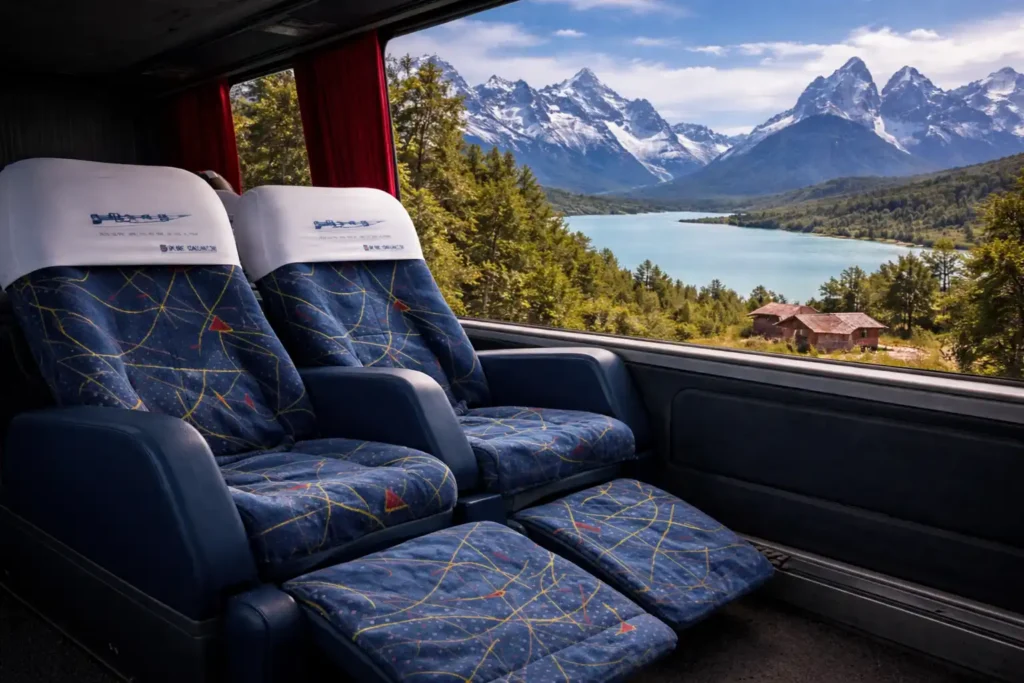
Long-distance travel in Latin America is often done by bus, and that’s something many foreign travelers aren’t used to. There’s often a certain reluctance around the idea — especially if you’re coming from places where long-distance buses have a bad reputation, or are seen as a last resort rather than a real option. I get where that expectation comes from: I’ve taken long-distance buses in Europe myself, including crossing into France, and it wasn’t exactly a great experience.
In Latin America, things work differently.
Distances here are much longer than in Europe, and the geography is on a completely different scale. Train systems do exist, but they’re mostly used for freight rather than passenger travel, and they don’t integrate entire countries or regions. Flights, on the other hand, are usually expensive, and while budget airlines have started to appear in the last decade, air travel still doesn’t offer good connectivity between many cities — especially when you take rural areas into account.
That doesn’t mean Latin America is poorly connected. Quite the opposite.
Because of these conditions, the region developed a wide and extensive long-distance bus network that connects countries, cities, towns, and even very remote places. In practice, buses will take you to almost anywhere you want to go.
With that in mind, traveling by bus in Latin America isn’t just sometimes the only way to get from one place to another, depending on where you are and where you’re going — it’s also a cheap, comfortable, and generally safe way to travel. Yes, trips take longer, but for many routes you can sleep through most of the journey, which changes the experience entirely.
Table of Contents
What long-distance buses in Latin America are actually like
Bus services in Latin America vary a lot from country to country, and even from one company to another. That said, there are certain things I’ve learned to expect when taking long-distance buses — and by that, I mean trips between cities that last more than three or four hours. This is not about urban or commuter buses. These are a different category altogether.
One thing I’ve learned after taking many more buses across the region is that how much the company matters varies considerably by country.
In Argentina and Brazil, services are fairly standardized. Some companies may be slightly cheaper than others, but buses within the same service category tend to be relatively comparable.
Peru is different. The company you choose can make a noticeable difference in comfort and service, particularly on long journeys. Cruz del Sur and Oltursa are two of the country’s most prestigious long-distance bus companies and, in my experience, they also offer better service overall. For a long or overnight journey, I think it’s worth paying a little more for a better operator rather than simply choosing the cheapest ticket.
Depending on where you are, you might end up on an older bus or a newer one, but in general they’re comfortable and surprisingly spacious. One of the standard features is onboard lavatories, which makes a big difference on longer routes. In some countries, like Argentina, buses are even required to offer onboard entertainment. Some companies do this through a Wi-Fi system that gives you access to a small streaming platform, which is actually pretty convenient. Others use different setups, but entertainment is usually part of the experience.
Another thing that’s very common — and honestly essential on long trips — is USB charging ports. Most long-distance buses I’ve taken in Latin America have them, which means you can use your phone without constantly worrying about battery life. This becomes especially important on journeys that last eight hours or more.
Buses also have a luggage compartment underneath for large bags, and inside the bus there’s usually space to keep a small backpack with you. As for comfort, the seats recline, there’s room to move, and overall I find them more comfortable than budget airlines. The level of comfort does vary depending on the class you choose, which is why it’s worth breaking those down separately.
Bus classes: semi-cama, cama, and ejecutivo
When booking long-distance buses in Latin America, you’ll usually see the comfort level listed using Spanish terms. The most common ones are semi-cama, cama, and ejecutivo (or an equivalent name, depending on the company).
The names are fairly descriptive. For reference, cama means “bed”, and prices usually increase based on how much the seats recline and how comfortable they are.
Semi-cama is the most basic long-distance option. Seats recline partially and buses usually have rows of four seats across. Sleeping is manageable, but upgrading to cama is worth it on longer trips because the price difference is often small and your back will thank you.
Cama (sometimes listed as coche cama) offers a much higher level of comfort. Seats are wider, recline much further, and cama buses have three seats per row (2 + 1) instead of four. The experience is often compared to sitting in a high-end movie theater, and on some routes you can even find single seats. While they don’t recline completely flat, they’re comfortable enough for overnight travel.
Ejecutivo is the top category, though what that includes can vary by company. In general, these seats nearly lie-flat and offer the most space and privacy. Some buses include curtains (cortinas) for each seat, and in Argentina this class is often called Tutto letto -or cama suite-, with seats that function almost like a flat bed.
Be aware that names can be tricky. In some countries — Peru is a good example — ejecutivo can actually refer to the entry-level service. For that reason, it’s always a good idea to look at the prices rather than relying only on the category name. Even if you’re not familiar with the terminology a company uses, you can usually infer the comfort level by comparing fares.
Not every company uses the same names, and not every route offers all three options, but these categories give you a good sense of what level of comfort to expect when choosing a long-distance bus.
Time and schedules
When you buy a long-distance bus ticket in LATAM, you’ll be given both a departure time and an estimated arrival time. In general, the total duration of the trip is fairly accurate. Delays can happen — accidents, road issues, weather — but most of the time the arrival time gives you a realistic idea of how long the journey will take.
Departure times are a bit more variable.
In some countries, like Brazil, buses tend to leave very close to the scheduled time. In others, such as Peru or Argentina, timing is not set in stone — especially if you’re boarding at a stop along the route rather than at the bus’s original departure terminal. In those cases, the listed departure time works more as a reference than a guarantee.
That said, this doesn’t mean you should arrive late. Quite the opposite. It’s still important to be at the terminal at least 30 minutes early, just in case. You never really know how early — or how late — a bus might pass through an intermediate stop.
Seat choice and when the journey is part of the trip
If you have the option to choose your seat, I usually recommend the top front section of the bus. On semi-cama buses, that typically means seats 1 to 4, and on cama buses, seats 1 to 3. While these seats often come with a bit more legroom, the main reason to choose them is the view. Sitting at the front on the upper level gives you a wide, uninterrupted view of the road, which can completely change the experience of the journey.
That difference matters because not all long-distance bus trips in Latin America are just about getting from one place to another. On some routes, the journey itself is part of the experience and is worth doing during the day. A few standout examples in Argentina include the Ruta de los Siete Lagos, between Bariloche and San Martín de los Andes; the Ruta de los Seismiles in Catamarca; and Ruta 41 in Santa Cruz, between Los Antiguos and Lago Posadas.
For other routes — especially long, functional connections — overnight buses can be a smart alternative. If you’re able to sleep reasonably well, you can cover long distances while resting and even save a night at a hotel or hostel. In those cases, comfort and efficiency matter more than the view.
Food and onboard service
Food and onboard service can vary a lot depending on the company and the country, but in general, complimentary meals or snacks are not something you should count on. Before the pandemic, it was more common for long-distance buses to offer small snacks, beverages, bottled water, and sometimes even a blanket and a pillow. After the pandemic restrictions, most of those services never really came back.
Because of that, it’s important to bring your own food and plenty of water, especially on longer trips. Some routes do include stops along the way where you can buy food or drinks, but this isn’t guaranteed. If the bus is running behind schedule, drivers may shorten stops or skip them altogether.
The safest option is to assume you’ll need to be self-sufficient and pack accordingly.
Documentation, boarding and border crossings
When taking a long-distance bus in Latin America, you’ll need to bring your passport with you. In most cases, that’s the only document you’ll be asked for.
If you bought your ticket online, you usually won’t need to print anything. Most companies will simply ask for your seat number to verify your booking. Depending on the country, you might hear it referred to as butaca, poltrona, or asiento — the word changes, but the idea is the same. It’s a good idea to remember that number, since that’s what staff will use to confirm your seat.
On routes that include a border crossing, bus companies will usually have you fill out an entry form online. If you haven’t done it in advance, they’ll let you know once you’re on board, before reaching the border. It’s a routine process and nothing to worry about.
The exact process, however, can be very different from one border to another. At some crossings, immigration and customs are handled in the same complex; at others, you may need to get off the bus, carry your luggage and cross part of the border on foot.
If your route includes one of these crossings, I have detailed guides based on my own trips:
- Puno to Copacabana by bus: Peru–Bolivia border crossing guide — what happens at Kasani, how much you’ll need to walk with your luggage, immigration, altitude and travel time.
- Mendoza to Santiago by bus: Argentina–Chile border crossing guide — Los Libertadores, Los Caracoles, customs and SAG controls, seasonal traffic and what to expect at the border.
Where to buy bus tickets
There are a few major platforms that make it easy to search and buy long-distance bus tickets in Latin America. Two of the most commonly used ones are Busbud and Plataforma 10. These platforms are useful for comparing routes, schedules, and prices across different companies.
One trick I often use is to search for the route on one of these platforms first, and then check the bus company’s own website. Sometimes tickets are slightly cheaper when you buy directly — though not always — so it can be worth comparing before booking.
That said, it’s important to keep in mind that local bus company websites aren’t always very foreigner-friendly. They may not be available in English, and some only accept local payment methods or require a local ID number. When that’s the case, using a more international platform can save you a lot of hassle. That’s exactly why, for example, when I ran into this issue in Brazil, I ended up booking through Busbud instead.
There’s another important difference between countries when it comes to booking. In Argentina and Brazil, I’ve generally found that buying through a platform doesn’t change the price dramatically, so the convenience can easily be worth it.
In Peru, I would compare the platform price with the ticket counter before buying. The difference can be surprisingly large. On my Puno–Copacabana trip, for example, I paid S/60 online for a ticket that was selling for S/25 at the terminal. If you’re already in town and can easily get to the terminal or the company’s ticket office, buying in person can save you quite a bit.
In Ecuador, and especially on more rural routes across Latin America, you may not find the bus online at all. That doesn’t necessarily mean the route doesn’t exist. Many local and regional services simply aren’t managed online, so the only way to confirm schedules — and sometimes even which company operates the route — is to ask at the terminal or buy the ticket there.
This is particularly important when planning routes through smaller towns: don’t assume that “no results” on a booking platform means “no bus.”
If you want a broader overview of the apps and digital tools that actually work on the ground while traveling independently, you can also check out Apps and Resources: The Essential Toolbox for Traveling Independently in Latin America, where I go into more detail about booking platforms, payments, and everyday logistics.
Final recommendations
- Luggage and boarding
Your large luggage will be stored in the luggage compartment underneath the bus. You’ll be given a small ticket or tag to claim it later — don’t lose it, as you’ll need it to get your bag back. - What to keep with you
Always bring important items, electronics, documents, and anything that could break into the cabin with you. Large bags go underneath, but your essentials should stay by your side. And also, always bring a pack of tissues with you. - Bathrooms on board
Long-distance buses do have onboard bathrooms, but I personally try to avoid using them. If possible, use the facilities at the terminal before departure. - Bus terminals and surroundings
Terminals themselves are usually busy and generally safe, even when you’re traveling overnight. That said, the neighborhoods around them aren’t always the safest — especially in large cities. Once you arrive, it’s best to go straight to public transportation or an Uber, rather than walking around the area. - Temperature on the bus
Temperatures inside long-distance buses can be extreme. In summer, air conditioning is often very strong and can feel freezing. In winter, buses tend to be quite warm. Dressing in layers is key, and even in summer it’s a good idea to bring a jacket or light blanket if you can. - Water and snacks
This is worth repeating: always bring water and snacks with you.
*Some links in this post are affiliate links. This means I may earn a small commission if you use them, at no extra cost to you. I only recommend tools I actually use or genuinely find useful.
Planning a trip around Latin America?
If you’re trying to figure out how to connect destinations, whether your route is realistic, or how much time and money you’ll actually need, I can help you work through it.
I offer personalized travel planning support to help you evaluate your options, answer practical questions, and make better decisions about your trip.