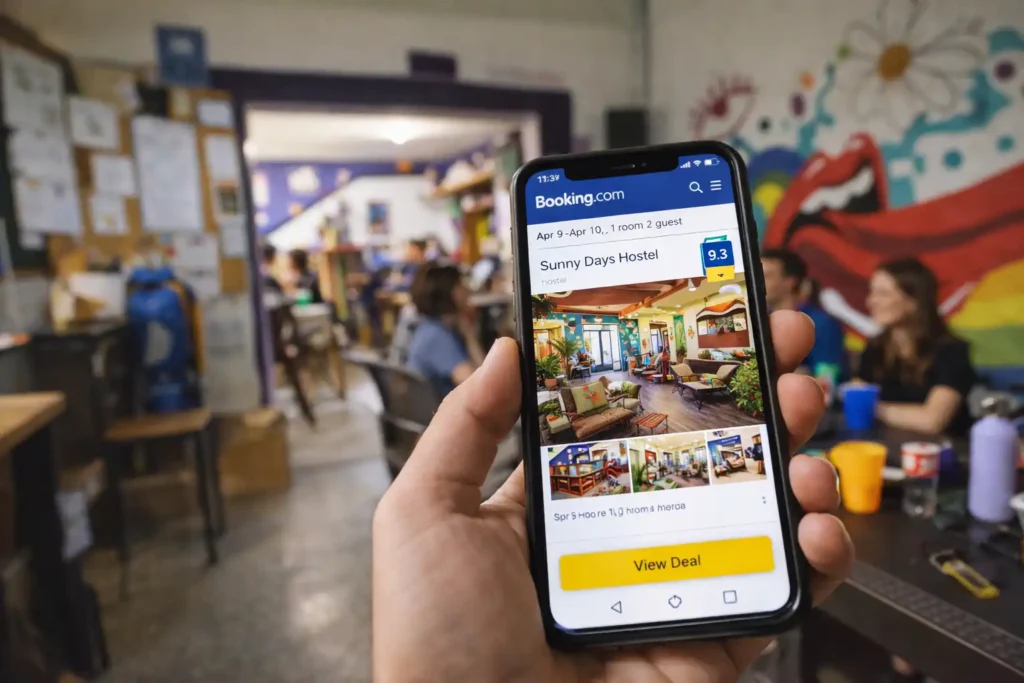
Traveling independently in Latin America isn’t complicated, but it does work a bit differently than in many other parts of the world. Some global apps are widely used and work well here. Others don’t. And in many cases, daily life relies on local platforms, alternative tools, or systems you might not be familiar with yet.
Knowing which apps people actually use — and which alternatives work better on the ground — can save you time, money, and a lot of unnecessary friction.
This is a practical list of apps and digital tools commonly used in LATAM if you’re booking your own accommodation, moving around on your own, and handling day-to-day logistics as you go. All of the tools listed here are free to install and use. Most can be downloaded before you arrive, while others may only appear in app stores once your location shows you’re in the region.
The goal is simple: to highlight what actually works in daily life while traveling through Latin America.
Table of Contents
Connectivity: eSIMs and local SIM cards
Getting connected in Latin America is usually possible, but the process — and how easy it is — depends a lot on the option you choose and the country you’re in.
eSIMs: the most practical option for most travelers
For independent and slow travelers, eSIMs are usually the easiest solution. You can buy and install them before you arrive, set everything up from home, and land already connected.
Many eSIM providers offer regional plans that work across several Latin American countries, which is especially convenient if you’re not staying in just one place.
If your phone supports eSIMs, this is generally the most straightforward and flexible option.
In my case, I use Saily. It offers good coverage across Latin America and has been reliable for the kind of slow, multi-country travel I do.
Physical SIM cards: where things get tricky
Buying a physical SIM card in LATAM isn’t always as simple as walking into a store and paying cash. In some countries, like Argentina or Chile, that’s a possibility, but in others -like Perú or Brazil- mobile lines must be registered under a person’s name. In practice, this means:
- You may be asked for local identification or residency
- Some providers won’t sell prepaid lines to short-term visitors
- The only option offered may be a long-term plan rather than a flexible prepaid line
A regional provider worth knowing
If you do choose a physical SIM card, and that’s a possibility in the country you’re going to, Claro is a provider worth looking into. It operates across much of Latin America and offers plans that include regional roaming, which can be useful if you’re traveling between countries rather than staying in one place.
Android, Apple, and why Google apps dominate in Latin America
When it comes to smartphones, Android devices are far more common than Apple devices across most of Latin America. iPhones are widely used and work perfectly fine here, but Android has a much larger presence overall.
That matters more than it might seem at first.
Because Android dominates the market, many digital services, platforms, and everyday tools are built — or at least optimized — with Android users in mind. As a result, Google products tend to be the most widely used and the most reliable option in many Latin American cities.
This doesn’t mean Apple devices won’t work. They absolutely do. But it does help explain why Google-based apps often feel more complete, better integrated, or simply more accurate when you’re moving around and handling daily logistics.
Location and navigation: Google Maps
For getting around, Google Maps is usually the most complete and practical option in Latin America.
Beyond basic navigation, it’s commonly used to:
- Find restaurants, cafés, and local businesses
- Check opening hours and reviews
- Navigate neighborhoods on foot, by car, or using public transportation
In many cities, Google Maps also provides public transportation routes and schedules, and while coverage isn’t universal, it works surprisingly well across a large part of the region.
It’s not a perfect or all-encompassing solution, but if you’re traveling independently and need a single app to help you orient yourself, make decisions on the go, and move around efficiently, Google Maps is usually the best place to start.
Driving and real-time traffic: Waze
For real-time traffic conditions, Waze is one of the most widely used apps across Latin America, particularly among people who drive regularly.
Because so many local drivers actively use it, Waze tends to be especially accurate when it comes to current traffic conditions. Congestion, accidents, road closures, and delays are often reflected quickly, simply because there’s a large and active user base feeding live information into the system.
While Google Maps works well for general navigation, Waze is usually the preferred option when timing matters — for example, when estimating how long a drive will actually take during peak hours, navigating large cities, or planning longer road trips.
Messaging and everyday communication: WhatsApp
In most of LATAM,WhatsApp is the default messaging platform. It’s not just popular — it’s essential.
If you’re coming from regions where people mainly use SMS, iMessage, or rely on social media DMs, this can be a noticeable difference. While platforms like Instagram are widely used, WhatsApp is still the primary way people communicate day to day.
This applies to both social life and practical logistics. For example:
- Tour operators often ask for your WhatsApp number to coordinate pick-ups or confirm schedules
- Hostels may add guests to WhatsApp groups to share announcements, activities, or connect travelers
- Locals usually exchange phone numbers with the expectation that communication will happen on WhatsApp, not via text messages
Because of this, having WhatsApp installed before you arrive makes things significantly easier, especially if you want to meet people, stay in touch with locals, or avoid missing important information related to bookings and services.
In many places, it’s simply assumed that you use WhatsApp — and not having it can create unnecessary friction.
Language and translation: tools that actually help you communicate
If you’re traveling independently in Latin America and don’t speak fluent Spanish or Portuguese, using translators is not cheating. It’s practical — and often necessary.
Language barriers are one of the main sources of friction while traveling: booking something, explaining a problem, replying to a message, or understanding instructions. Having the right tools on hand makes everyday situations smoother and reduces unnecessary stress.
Most travelers end up using a combination of tools, depending on the situation.
Google Translate: quick checks and single words
Google Translate is still useful for very specific tasks, such as:
- Translating single words or short phrases
- Understanding signs, menus, or written instructions
- Doing a fast check when you’re unsure about a word
It’s not always accurate for tone or natural phrasing, but it works well for quick, practical needs.
ChatGPT: context, tone, and real communication
For anything involving actual interaction with people, I personally rely much more on ChatGPT.
Instead of translating word by word, I use it to understand how something is said — not just what it means. This is especially useful when:
- You need to reply to a message from a hostel, tour operator, or local contact
- You want to sound natural instead of overly formal
- You’re unsure about idiomatic expressions or local usage
- You need help choosing the right tone (casual, polite, direct)
Used this way, ChatGPT becomes less of a “translator” and more of a communication assistant.
I wrote a separate guide explaining exactly how I set it up while traveling — including practical prompt examples and different scenarios (from survival communication to navigating regional language differences).
You can read it here:
Why ChatGPT is my travel translator and language assistant
Translation tools and learning on the road
Using translators doesn’t prevent you from learning the language — in fact, for many travelers, it’s the opposite.
When you’re translating messages you actually need to send, or phrases you actually want to say, language stops being an abstract subject and becomes something functional. Over time, patterns repeat, expressions stick, and understanding grows naturally.
If you’re curious about how this works in practice, you can read more about it here:
Can you learn Spanish while traveling?
Payments: cards, contactless, and QR systems
Across much of Latin America, paying with a debit or credit card using contactless technology (tapping your phone or card) is now one of the most common ways to pay, especially in shops, cafés, and restaurants. In many places, this works just as smoothly as it does elsewhere.
At the same time, some countries have developed widely used QR-based payment systems that coexist with card payments and, in certain contexts, are even more common.
QR payments in Argentina and Brazil
In countries like Argentina and Brazil, QR payments are part of everyday life. While each country has its own system, the same app can be used to operate across both.
One option is Airtm, which allows you to:
- Pay QR codes used in Argentina (commonly associated with platforms like Mercado Libre and local wallets)
- Pay using Pix, the instant payment system widely used in Brazil
From personal use, Airtm tends to have lower commissions compared to other alternatives, which makes it a practical option if you’re moving between countries and want to avoid juggling multiple apps.
Another option is Lemon, which also supports QR payments and adds the possibility of paying with cryptocurrency, though commissions are usually a bit higher.
A practical note on connectivity and backups
Digital payments are widely used, and in practice, connectivity is rarely a real obstacle. Even if you’re in a remote area with no mobile reception, chances are that the place you’re paying at will still have Wi-Fi they can share with you, simply because charging people by phone is so common.
That said, it still makes sense to carry some cash as a backup, for emergencies or edge cases. Not because digital payments don’t work — but because having alternatives makes things easier when you’re moving around.
Public transportation and contactless payments
Contactless debit and credit card payments are not available everywhere, but they are already used in some countries. In places like Argentina and Chile, contactless payments are accepted on certain public transportation systems, such as trains or subways, and they are now starting to be introduced on buses as well.
Availability still depends on the country and the city, and this is an area that’s actively changing, so it’s something to check locally once you arrive.
Ride-hailing apps: Uber and Cabify
For getting around cities, Uber is still the most widely used ride-hailing app across much of Latin America. In many places, Cabify is also very common and used interchangeably with Uber, depending on the city.
Local taxis are not usually unsafe, and many people use them daily without issues. However, if you’re a foreigner, don’t look local, or aren’t familiar with the city, it’s not uncommon for drivers to take longer routes to increase the fare.
Because of that, using ride-hailing apps is often the easiest way to avoid misunderstandings. Prices are set in advance, routes are tracked, and you know what you’re paying for. That’s why, in cities I don’t know well — or where I clearly stand out — I personally stick to Uber.
Food delivery apps: what people actually use
In most large cities across Latin America, Uber Eats works perfectly fine and is widely available. If you already use it, you won’t need to relearn anything.
That said, depending on the country and the city, the same restaurants are often available on local delivery apps — sometimes at lower prices. Fees, promotions, and availability vary a lot, so it’s common to compare.
Some of the most widely used local platforms include:
A very simple way to figure out which app works best in a new city is to pay attention to delivery backpacks when you’re walking around. The brand you see most often is usually a good indicator of:
- Which app has the largest user base
- Which one has better coverage and faster delivery
- Where locals are actually ordering from
That kind of quick, visual check often tells you more than app store rankings.
Booking platforms and touristic services
While flights are usually booked through international platforms, there are a few tools that are commonly used in LATAM for buses, accommodation, and local tours.
Bus tickets (long-distance travel)
For buying long-distance bus tickets online, some of the most commonly used platforms are:
Availability and coverage vary by country, but these platforms are widely used for intercity travel.
If you’re not familiar with how long-distance buses actually work in Latin America — including comfort classes, schedules, and what to expect on board — you can read more here:
Why you are wrong about buses in Latin America (and why you’ll end up loving them)
Local tours and attractions
For tours and activities, it’s often best to book directly with a local travel agency once you’re there. That’s usually where you’ll find the most updated information and options.
If you prefer to check things online in advance, commonly used platforms include:
Accommodation
For booking accommodation, the most widely used platforms are:
- Booking.com
- Airbnb
- Hostelworld (to a lesser extent)
You can also use Trivago to compare prices across different booking sites.
As everywhere else in the world, informal accommodation bookings come with risks, and scams do exist. While you may see listings shared through social media, messaging apps, or word of mouth, this is one area where it’s usually safer to stick to established booking platforms.
Using larger platforms adds a layer of security, clearer conditions, and some form of support if something goes wrong. In many cases, they’re not only safer but also cheaper once you factor in reliability, verified listings, and payment protection.
Hostel work exchanges: Worldpackers
If you’re thinking about doing a work exchange at a hostel — working a few hours a day in exchange for accommodation — Worldpackers is the platform I’d point you toward.
There are other ways to find exchanges: writing directly to hostels, searching Facebook groups, asking around. Those can work. But Worldpackers adds something the informal route doesn’t: a clearer structure. Listings are more transparent, agreements are more defined, and if you arrive somewhere and the situation doesn’t match what was described, the platform can help you find an alternative and cover accommodation in the meantime.
It has an annual membership fee, but for a first exchange especially, that safety net is worth it.
If you’re considering this kind of travel, I wrote a full guide on how hostel work exchanges actually work — including what to expect, what to clarify before you arrive, and what Spanish level you’ll need: Hostel work exchanges: what they actually are, how to find one, and what to expect
Travel insurance: options that work well in Latin America
If you’re traveling independently through Latin America, having travel insurance arranged before you leave is still an important part of your setup. These are two options that work well in the region and are commonly used by long-term and independent travelers.
For a deeper look at how healthcare actually works in Latin America — and how travel insurance fits into that system — I’ve written a full guide here:
Travel insurance in Latin America: how healthcare horks and what to consider.
SafetyWing
SafetyWing is a good option if you’re traveling in a flexible or long-term way and don’t want to be tied to rigid dates.
What makes it practical:
- Worldwide coverage
- Monthly renewals
- Designed for travelers with open-ended plans
This makes it a common choice for people traveling slowly or moving between countries.
Assist 365
Assist 365 is a more traditional travel insurance, but within that category it’s relatively flexible and works well across Latin America.
Plans are quoted for specific trips and durations, so it’s best to arrange coverage before you start your journey. While it may be technically possible to purchase it later, it’s not practical and can leave gaps in coverage.
One clear advantage is transparency: plan conditions explicitly state that there are no copays or deductibles, and they include at least partial coverage for emergencies related to pre-existing conditions, which isn’t always standard.
Assist Card is another widely used travel insurance provider in Latin America, known for its broad regional coverage.
*Some links in this post are affiliate links. This means I may earn a small commission if you use them, at no extra cost to you. I only recommend tools I actually use or genuinely find useful.
Planning a trip around Latin America?
If you’re trying to figure out how to connect destinations, whether your route is realistic, or how much time and money you’ll actually need, I can help you work through it.
I offer personalized travel planning support to help you evaluate your options, answer practical questions, and make better decisions about your trip.