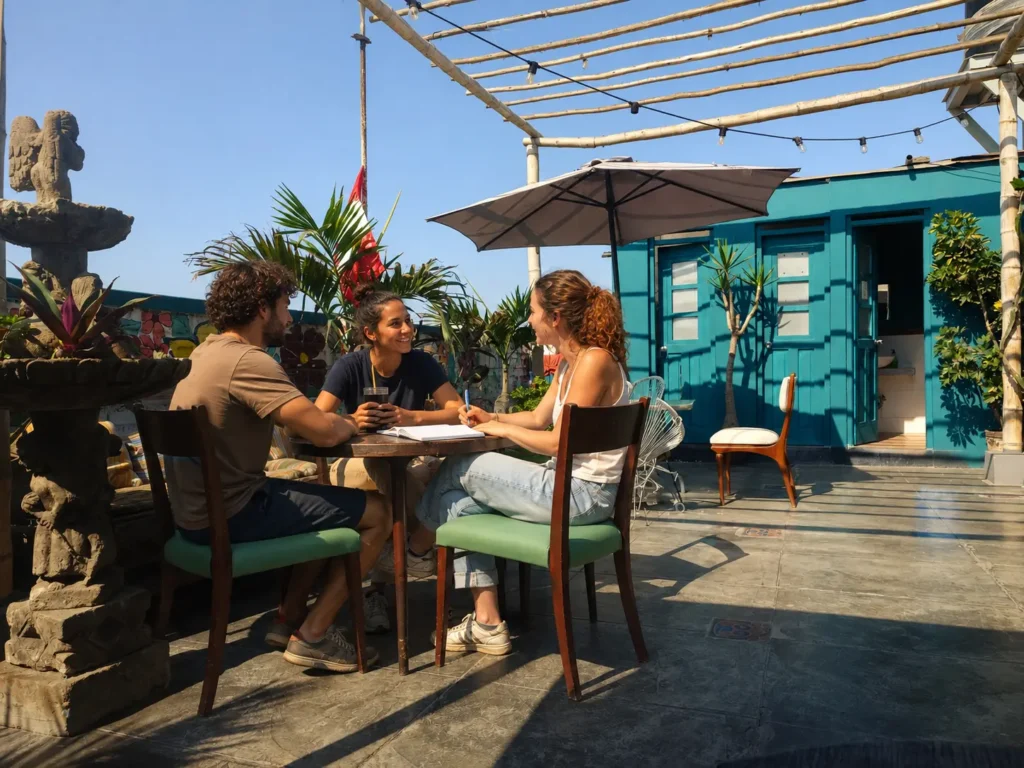
There’s no shortage of resources for learning Spanish — apps, courses, tutors, YouTube channels. Not all of them will get you speaking Spanish, and the best approach also changes depending on what you’re learning it for. If you’re a digital nomad or planning an extended stay in Latin America, the way you learn doesn’t have to be the same as someone learning with a different goal in mind.
You need both grammar and production — not just an app
A lot of people assume that repeating phrases in an app, day after day, will eventually add up to speaking the language. It doesn’t work that way. You need to learn grammar — the rules of how Spanish works — and you also need to practice production: building your own sentences from scratch, in real time, instead of recognizing the right one out of a few options on a screen.
Apps like Duolingo are built almost entirely around that second, easier skill: recognition. You get fast at picking the correct answer, and it feels like progress. But picking the right sentence and producing one yourself, mid-conversation, with no options in front of you, are two different skills — and only one of them is what a real conversation actually asks of you. That’s why people who’ve done months of an app still freeze the first time someone asks them something unscripted. I wrote more about that gap here.
There’s a reason people study to become teachers. Not everyone learns the same way or at the same pace, and that’s exactly what an app or a self-guided method can’t give you: feedback, and someone adapting to what you specifically need. That’s what a teacher gives you, whether it’s one-on-one tutoring or a small group class.
You don’t need a year of prep, but you can’t start from zero either
You don’t need to arrive speaking well. Waiting until you feel “ready” is usually just a way of postponing.
But arriving with zero base doesn’t work either. Immersion on its own — just being surrounded by the language — doesn’t teach you nearly as much as people expect, because without something to attach what you’re hearing to, most of it is just noise. Worse, being thrown into native-speed Spanish with no base can be genuinely frustrating, to the point where people give up on it instead of getting closer. A small base changes that completely: the same conversation on the street goes from background sound to something you’re actually picking apart and learning from.
In practice, that’s what tends to work best: build a foundation before you go, then let immersion accelerate everything once you arrive. Not because immersion doesn’t matter, but because it works so much better once you’ve given it something to build on. I go deeper into that here.
Once you’re there, a teacher can also help you make sense of what immersion actually throws at you — a confusing lease clause, a strange exchange at the panadería — instead of you having to puzzle through it alone.
A course for a long stay should prioritize differently — not teach different grammar
A typical Spanish-for-travel course doesn’t quite fit either. Those courses are usually built around short trips: checking into a hotel, ordering at a restaurant, asking for directions, booking a tour. You’ll need some of that too, but if you’re staying for a few months, you’re not just visiting — you’re building a temporary everyday life. You’ll be figuring out where to buy groceries, joining a gym, doing laundry, dealing with a landlord, finding places to work, and solving all the small practical things that never make it into a vacation phrasebook.
It’s still a Spanish course. Same grammar, same core language you’d find anywhere. What should change is the vocabulary and the situations it’s built around.
Most courses are designed for a classroom or a short vacation, so they teach you your family members, your hobbies, the weather, long before they teach you anything close to what you’re actually going to need. If you’re settling into a city in Latin America for a few months, none of that comes first for you. What comes first is handling payments and withdrawals, sorting out a gym membership, understanding what a rental actually includes, going to a farmacia and describing a symptom, getting through migraciones without freezing when they ask how long you’re staying — the situations that are actually going to show up during your stay, not chapter twelve of a textbook that was never written with you in mind.
So, where do you start?
Learn the grammar. Practice producing it, not just recognizing it. Build a base before you leave, even a small one, and keep learning once you’re there so immersion has something to work with. And learn it through the situations you’re actually going to live, not the ones a generic course assumes come first.
If you’re planning a long stay in Latin America and want to learn Spanish this way, I’ve built a one-on-one program specifically for digital nomads and slow travelers. Explore the program and how the classes work