Learning Spanish while traveling often sounds simple: you arrive, you listen, you adapt, and eventually it clicks. For many travelers and digital nomads in Latin America, immersion feels like the most natural and obvious path to learning the language.
But in practice, learning Spanish while traveling depends much less on where you are and much more on how you’re actually living and moving through those places. And even with full immersion, it doesn’t always lead to learning in the way people expect.
In this article, I’ll break down the real upsides and limitations of learning Spanish while traveling, and explain why context plays a much bigger role than people usually expect.
Pros and cons of learning Spanish through immersion
Learning Spanish through immersion is not the same as learning it in a classroom. Traveling puts you in constant contact with the language, which can be incredibly helpful in ways formal study often can’t—but it also comes with limits that shape how, and how much, you actually learn along the way.
That tension is what makes learning Spanish while traveling both appealing and frustrating, and worth looking at more closely.
Benefits of immersion
Studies show that people tend to learn a language faster when they are living within the culture where it’s spoken, simply because they are more exposed to it. The language is learned in context, across different registers, and in a more colloquial, natural way. You’re not learning “textbook Spanish”: you’re picking up the words, expressions, and rhythms that locals actually use.
When you’re living in a Spanish-speaking place, the language stops being an object of study and becomes functional. Spanish turns into a tool you need for everyday life: buying groceries, booking a tour, asking for directions, handling paperwork, or having small, casual conversations. You use it because you need it, not because it’s part of a lesson.
The context also leads to something else: the conditions for meaningful learning. Words and phrases are no longer isolated; they’re tied to real situations and memories. You remember a verb because you used it at the market, or a phrase because it helped you solve a problem. As a result, what you learn is often easier to acquire and more likely to stick.
The downsides
One of the main risks of learning Spanish through immersion is fossilization. When people are learning the language in a functional way, their priority is communication: being understood and getting things done. Locals often understand what the learner is trying to say, notice the mistakes, but don’t correct them. This is very different from what happens in a classroom.
The result is that you repeat the same mistake over and over again. At some point, that error becomes fixed in your mind, and later it’s surprisingly hard to change. This is why many people who learn Spanish mainly through immersion tend to have very specific, repeated mistakes in certain phrases or structures. Without feedback from a teacher or tutor, there’s nothing interrupting that pattern.
Another common issue is what I like to call lagunas mentales (something like “Swiss cheese knowledge”). These gaps usually appear in more structural areas of the language: grammar, spelling, or understanding a rule but not knowing when or how to apply it. You might recognize that a grammatical structure exists, but still feel unsure about using it correctly. This usually comes from a lack of systematic grammar and structural study, which immersion alone doesn’t always provide.
Immersion can also be frustrating. When you’re at a beginner level, say A1, you’re suddenly exposed to fluent speech from day one. That level of exposure can be overwhelming. Constantly translating in your head, trying to keep up with conversations that move much faster than your own ability, is mentally exhausting. Over time, that exhaustion can turn into frustration, and frustration can easily lead to a loss of motivation. In some cases, people simply stop trying.
There’s also the issue of misunderstanding. When you learn through immersion, people don’t always explain the contextual or cultural meaning of words. In Argentina, for example, boludo can be a friendly term, but it can also be an insult depending on tone and context. Without guidance, it’s easy to misinterpret these nuances—or use a word in the wrong way—and that can lead to awkward or uncomfortable situations. It’s also worth remembering that learning a language isn’t only about vocabulary or grammar; it’s about learning a culture as well.
Not all contexts help
Being in Latin America doesn’t automatically mean being immersed in Spanish. Many travelers spend months in the region while remaining inside an English-speaking bubble, with very limited real exposure to the language.
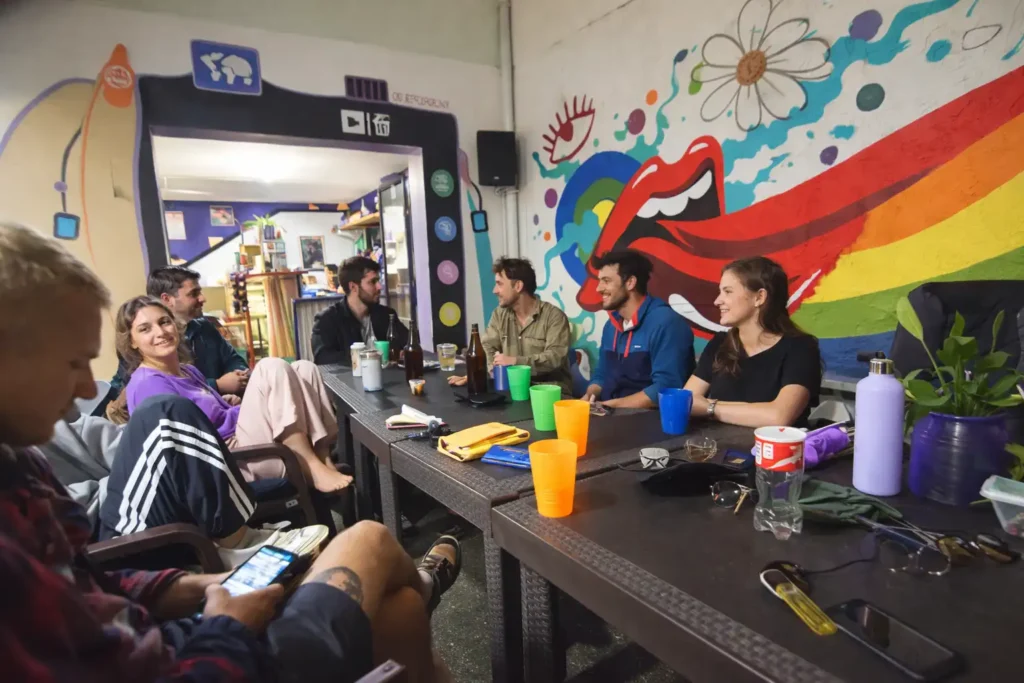
This often happens with expat communities, certain hostels where everyone defaults to English, or highly touristic areas designed around international travelers. In those environments, you don’t really need Spanish to function. You can book accommodation, order food, socialize, and solve most daily needs without ever leaving English. As a result, even people who stay for long periods sometimes don’t move beyond the basics—or never even learn them. Being surrounded by Spanish is a start; being engaged with it is the goal.
So while people often say “I’m living in Latin America, so I’m immersed,” the reality is that presence alone doesn’t guarantee meaningful contact with the language. If your daily life doesn’t require Spanish, exposure stays superficial.
There’s also the social side of it. In very international or heavily touristic destinations, some people are less patient with foreigners trying to practice the language, especially when communication feels slow or inefficient. This can make learners default back to English even faster. That said, this is more the exception than the rule in Latin America. In most places, locals are genuinely encouraging when they see someone making an effort, and are often happy to help—even excited about it.
So, can you learn Spanish through immersion?
Yes—but not by magic.
Immersion can absolutely help you learn Spanish faster, and in many cases it makes the process feel easier. But, as hard as it is to accept, Spanish doesn’t teach itself. There’s a real difference between simply being in a place and actually connecting with it, and that second part is much harder to achieve without some form of support.
Research and experience both point in the same direction: combining informal learning through immersion with some level of structured support tends to make the process more effective. Not more intense, just more intentional. That combination is what helps turn exposure into learning, instead of leaving it to chance.
That’s also how I work as a teacher. My goal isn’t just to teach grammar, but to give you the tools to actually connect to the places you’re visiting. If you’re already investing time and money in traveling through a Spanish-speaking region, adding one or two hours a week of focused language work can make a noticeable difference. It’s often what allows people to move from “getting by” in Spanish to actually enjoying it.
If you’d like to take a look at your Spanish level, your travel plans, or both, you can book a free 15-minute intro call with me here.
We can talk through where you are, what you’re trying to do, and whether Spanish classes, travel guidance, or a mix of both would make sense.
If something here was useful — or if you feel something is missing — you can send me a message through this form.
It’s a private message, not a public comment.